Showing posts with label m2m. Show all posts

Monday, 14 May 2018

Real IoT 2018: Smart Bicycle (continued from 2016 article)

Following on from the 2016 realworld IoT article on IoT and M2M, as we used to call it :), is a 2018 view on how that has update, again via another Kickstarter success.

Here at Conecto IoT HQ we have been testing quite a few innovative travel and sprot related IoT products that are interesting in that they pose a problem for non Cloud IoT platforms, in that:

  1. Nobody knows their usage pattern, which causes problems for "box and wires" IoT as they do not know how to dimension the service
  2. Lot's of people get obsessed with them being either high bandwidth 4G (not needed, honestly) or crappy 2G which is being turned off quicker than any new IoT models can go mass market, more on that below.
Many of these have been in the cycling space, and are confidential / require permission to publish, however one I want to share is public, and its the long awaited Hammerhead Karoo, which I have now had time to test with a Conecto IoT Connect SIM, which is sold to customers on AWS IoT platform via one of our partners and is available in test packs by contacting Conecto directly and making your case.

The British Summer is a great testing ground for riders ability to apply the Velominati cycling rule #9 as well as test IoT
And this is where the true meaning or Real World comes in. Everybody is talking about IoT needing 100s MB or even GB, but that is the key: these people are just talking about IoT. People who are actually doing IoT know that for every high bandwidth SIM, there are literally thousands to millions of low bandwidth SIMs, and volume my friends, is all that matters in IoT!

So it was refreshing for Hammerhead to do two things with the Hammerhead Karoo while I was busy testing 4 SIMs, 18 IMSIs and 4 IoT devices on a typical rainy summer's day in the UK
  1. They have paired it down to the bare bones of android, even to the point that when I signed in on Google I had an alert from an "unknown OS"! More on that in a bit; it would at least be nice to see the Operator logo, since I spent 5 mins, the time it takes on the Conecto platform, to edit the SIMs service provider name to "Hammerhead".
  2. The devices is 4G ready, but does not have 4G enabled yet. This is good, due to the roaming nature of the Conecto SIM I always had 4 to 5 bars of signal, even in the depths of the Surrey Hills, and this was good as we will see later. So many devices are 2G only and we can see that in dense urban areas in the UK these have now been turned off, as has 2G in its entirety on the AT&T network. 
So onto the good bits, how much data does it use and is 3G a substitute for Wi-Fi. Well yes and no. By pure coincidence Virgin were working on my Wi-Fi when I was trying to download a route, so I switched to 3G and

  • The Karoo downloaded a 92km route with Maps very quickly with a total of 31,784,010 bytes, or 32mb to you an me, and that was with a download failure in the middle due to, ok me taking the device past the part of the building I call the "faraday cage". Obviously that would not have been as much fun for the obligatory software update that went before it, however, which fortunately I had Wi-Fi for. Even if I did not have Wi-Fi for it, I would have gone past somewhere I know that has it before the ride, like the office, or local cafe.
So how much does it use in a ride, I hear you ask??? Well I can tell you:

  • During a 92km ride the Karoo used 9,847,998 bytes exactly, or 10mb to you and me, and this was a ride which due to me entering and leaving a faraday cage of an entrance 3 or four times to still misjudge clothing and accessories for British summer (wet) riding, I had the "Waiting for GPS error" all the ride, something I would normally have to restart other GPS devices for, but the Karoo was tracking the route better than the devices the route was done on, so left it using the mobile signal a-GPS to keep riding; again, win for the SIM device!
Despite the "waiting for GPS" warning, with a SIM in it the Karoo tracked the route better than the source GPS route!
So what is my point here? Well it's to force home the fact that even this high end Android device could get by using less than 100mb a month, and its here today making our life easier and saving us previous hardware reboot and satellite search time... This is also important as it also affects battery life. I got the same battery usage as people in the forum got with Cellular / mobile turned off, which is important for the data on the go. There is no point my being able to download a software update on the fly if it then (inevitably) gives me range anxiety on a long ride.

Also, in case you are wondering, the average IoT SIM on our platform uses 1.2Mb per month, with the vast Majority being under 1Mb and a small % being in the 10-100mb zone.

Also read the 2016 Realworld IoT article on smart bikes

Friday, 9 March 2018

Real World IOT that happened in 2017 and will grow 2018 - Smart Luggage

This is the second in a series of entries on IOT in the real world that impact people's lives directly, i.e. what is not just a predicability of the future, but things that are going to happen! smart luggage has been a while in the making, with the big brands dabbling for years, however as they have appeared on kickstarter successes already; mainstream will finally dig out their initiatives, dust them down and follow. If they don't, you know where to spend your money doing it yourself or buying from the likes of G-Ro.
OK not a great photo, but here you see the G-Ro, plus tracker, and wi-fi hotspot set-up set-up myself.
Why is this important? Well, we have all heard of smart fridges, etc. however there are two problems with the smart fridge:
  1. fridges are large "white goods" that are unlikely to be on kickstarter
  2. Fridges fall very, very heavily into the corporate dilemma above, where staff in organisations that make fridges are no longer rewarded for innovation. In fact sometimes quite the opposite, cost reduction, conformity and who is longest in the office sucking up to their boss will never create innovation.
I am sure that after using a smart fridge, for now at least, we kind of are ok or even happier with our “just as we want it” premium fridge, or in fact just a fridge. The difference of real world IoT is when you try something and know you can never go back, no matter how premium your non msart version is. Great examples ate smart watches. I have had versions, and not all of them were quite there, I had various garmin devices: 310xt, 910xt, Fenix 2, however once I put the Fenix 3 on, my premium swiss chronograph never went on again. The same, if not moreso, happened with smartphones.


Why smart luggage?

I travel a lot, both personal and business, and have always spent the extra to have decent luggage. By decent I do not overly expensive… in many places arriving with expensive luggage that is like screaming “follow me from the airport and mug me”, but in that the luggage has decent wheels, zips, compartmentalisation and built to last the rough and tumble of travelling without arriving like some luggage you see with a wheel missing, or a wayward handle or weighs half your weight allowance before you have even packed it. Despite being descent, This has meant sometimes fixing my own luggage, I have preplaced wheels whose bearings have worn out, handle pins that broke and even a handle… but the quality of a good Samsonite or Antler superlight luggage mean its all fixable wherever you may find yourself on this globe.
After peace of mind, the biggest advantage of smart luggage is saving time on arrival

Saving time on arrival

One of the biggest benefits of smart luggage is its saving time on arrival and smart luggage does this in a few ways:
  1. If your luggage is lost, by the time you land it will tell you and you do not have to wait until everybody has left the conveyor and there is a 2 hour queue of other people with lost luggage in front of you. It also saves time again, as usually when you report lost luggage it takes them a day or more just to work out where it is: you can tell them its in terminal X y airport y from the off and you get your bags back way earlier
  2. Proximity, proximity is amazing as more or less, and with a certain margin of error, its able to sense a) when your luggage has arrived outside the conveyor, and b) by if its close by, again leaving your time to catch-up with all things mobile notifications related before your luggage arrives
  3. Other errors. Sometimes your back says its in the right airport but your, or luggage staff can see its gone to the wrong conveyor... this last happened to me arriving back to heathrow at nearly11pm... the staff said you can either wait about an hour or we will send it to you tomorrow... that was an easy choice!
  4. Being shipped back: when your luggagesis being shipped back to you, you are not at the mercy of the courieror 3rd party updates that arrive an hour or a few after the event. As your luggage leaves the airport you know it, and if like once they cannot, or pretend they cannot find you to go home early... then you say: I can see you are just around the corner, do me a favour and do your job. Yes that has happened... and not just once!
You can even track your luggage as it makes its way via courier back to you after delivery to the wrong airport!

Battery Life

One of the issues with trackers is that they tend to be built to a price, and that price does not seem to run to batteries... While high end ones I have built myself or been part of specifying for clients have higher end batteries that have higher power, and are consistent (one batch of cheaper trackers that were specified to have 700mah batteries had 200mah, 400 may and 500mah across the first three tested)!

On that note I have taken to using lithium or high end rechargeable batteries on the trackdots, although for some reason they say not to (one assumes that network resources hurt profits, but again we have a solution for that which we worked out for a customer). The best, and most responsible, solution is rechargeable, with 2100mah Panasonics managing up to 10 days across 5 airports recently.
With rechargeable batteries (not recommended by manufacturer) the track dot can manage 10 days tracking, two of those it was awake in a car highlighting all the airports on the way :)

Requirements to DIY smart luggage.

There are basically, from I can work out from my own needs and those of people I travel with, as well as what G-RO are productising:
  1. Location
  2. Power
  3. Hotspot/connectivity


Trackdot, etc was my first port of call for location.


Trackdot and the G-Ro devices which is a rebranded lug track I believe, are very slick at what they do, but I cannot help but see it as a one trick pony with limitations. First the good: its very slick: you turn it on with one button, and track through a simple app, though you do need to read the manual. The apps are simple, though, despite pioneering Bluetooth since its inception, and having one an innovations award in 2001 for stretching its limits, I could not get the trackdot thing to connect via Bluetooth.

My second port of call for location was using certain MiFi devices with GPS in the chipset, which allow you to access the location; however, like the cheap GPS devices from Alibaba, ebay, etc: when you arrive at an airport you want to just open an app and see where your luggage is, not a web page or web pages... this is 2018...
Bad: cannot be waken from sleep remotely (at least not to consumers), does not have GPS for real tracking of needed, AA batteries and no micro-USB mean no way to back-up / extend batteries (yes I am aware AA are readily available, but not always within time restrictions of business / flight schedules). This is how I started using rechargeable batteries despite the warnings not to, as I stole the two batteries from my DSLR camera Flash!

Power The next category is power, which is a bit more difficult.

Whilst there are a plethora of batteries out there, there are a few things to bear in mind. 

  1. power; over 27,000mah and its considered a fire risk by most countries, so avoid building a portable generator :)
  2. more importantly, how it wakes up: most require you to pres a button or insert the USB cable into the battery to wake up, which means you cannot bury the battery at the bottom of your case behind the lining out of the way. The best for this is the white tp-link 21000 battery usb one from the image above of the suitcase - whenever you plug something into a cable on the end it charges... and will not turn off if the draw is too low on the wifi router.
  3. charge and be charged. Many devices can either charge or be charged, which when travelling is not always ideal and means more devices

The one that comes with the G-Ro is quite good, but its heavy, only has two USB ports, a charger you do not normally travel with, but moreover its tablet format means its constantly being stopped in security, which is very not good as it wastes time you will never, ever get back!

The Anker usb-c Battery ones are solid alloy and well built, and some have usb-c, but they cannot charge and be charged.

Rav power make a 26,800mah one, but it needs the button be pressed to activate.

One of the main reasons for having batteries that can be charged while charging, is that you can use them as a charge point in the hotel, and also when out and about in good sunlight, you can solar power your smart luggage, and complete your off the grid, ready for anything collection!

Wifi access point. 

So this is not in the G-Ro but is not difficult to add either with a wifi or a dongle and a router, which has more uses when travelling as you can use it as a bridge for hotel / airport wifi. Since 2014 many Huawei MiFIs also have this built in, as do others. You can always use a second handset, which I often also carry as a back-up anyway, but they can get very, very hot in luggage!


Huawei has two devices, the E576 and the E5772, the former 3G and the latter 4G. There are others, however these devices have both GPS and can handle SIM toolkit, so will work with all types of SIMs, including my own IoT MVNE Company Conecto SIMs with multiple IMSIs.


Tuesday, 13 May 2014

2014 finally year of Digital Automated Home (and proper BI)

Why is the digital home finally coming around? its BI (Business Intelligence) probably

The automated home has been a long time coming, over 10 years ago I marvelled at the remote control curtains in his UK house that my colleague Keith could command from his holiday home in Florida, however, while very impressive, and capable of doing many things, the reality was that putting it together was not easy, even the hardware design of X10 stuff was very "engineer with no brief or requirements" which meant usability was low and a knowledge of coding necessary.

Years have gone y and things moved on; and while products like the nest weather station, connected cars, etc. I suddenly came out of new year's celebrations with a 2014 full of home automation, first we had Google buying Nest and the whole world, including giant Samsung joining the smart watch race.

But why is 2014 connected home year all of a sudden? Why these purchases? Well for me its simple; from years of building MVNOs I have seen that thoese that truely know their customers and can adapt their BI to fit win. They don't just win by a small amount, like the majority of companies that constantly mine their BI for small, incremental gains, these are companies that leverage what they know about their customers and say:

"these are our first 100,000 customers who will buy our new mobile service because they have bought this, this and this from us, they consume this media, live in this area, have this sociodemo group, and we are marketing them both directly and indirectly in these ways that achieve this conversion"

And they do that as the key to understanding them is how they live and from that what makes them tick, or otherwise, what makes them buy. Clever supermarkets get this data from your credit cards and shopping bills (place and sociodemo group as well as purchase preferences) for example. But what to do if your customer is more anonymous? what to do if your BI is not up to scratch? well buy a company or create a product that can give you this data that fits with your business.

The Google Nest acquisition will tell Google how many people there are in a household, the sociodemographic derived from location, when the house is heated and spend, how people share households, who manages certain aspects of a household, etc. Even anonymously, this data can tell you how to charge effectively for ads to the household and mobiles and can be critical for their core business.

Samsung sells fridges and phones and TVs, combine these with a smart watch that can tell when people exercise and preferably what they do or should eat, and the ecosystem from what entertainment products to the really smart fridge starts coming together with real data - not some guys in a room trying to come up with products based on his or her own personal experience.

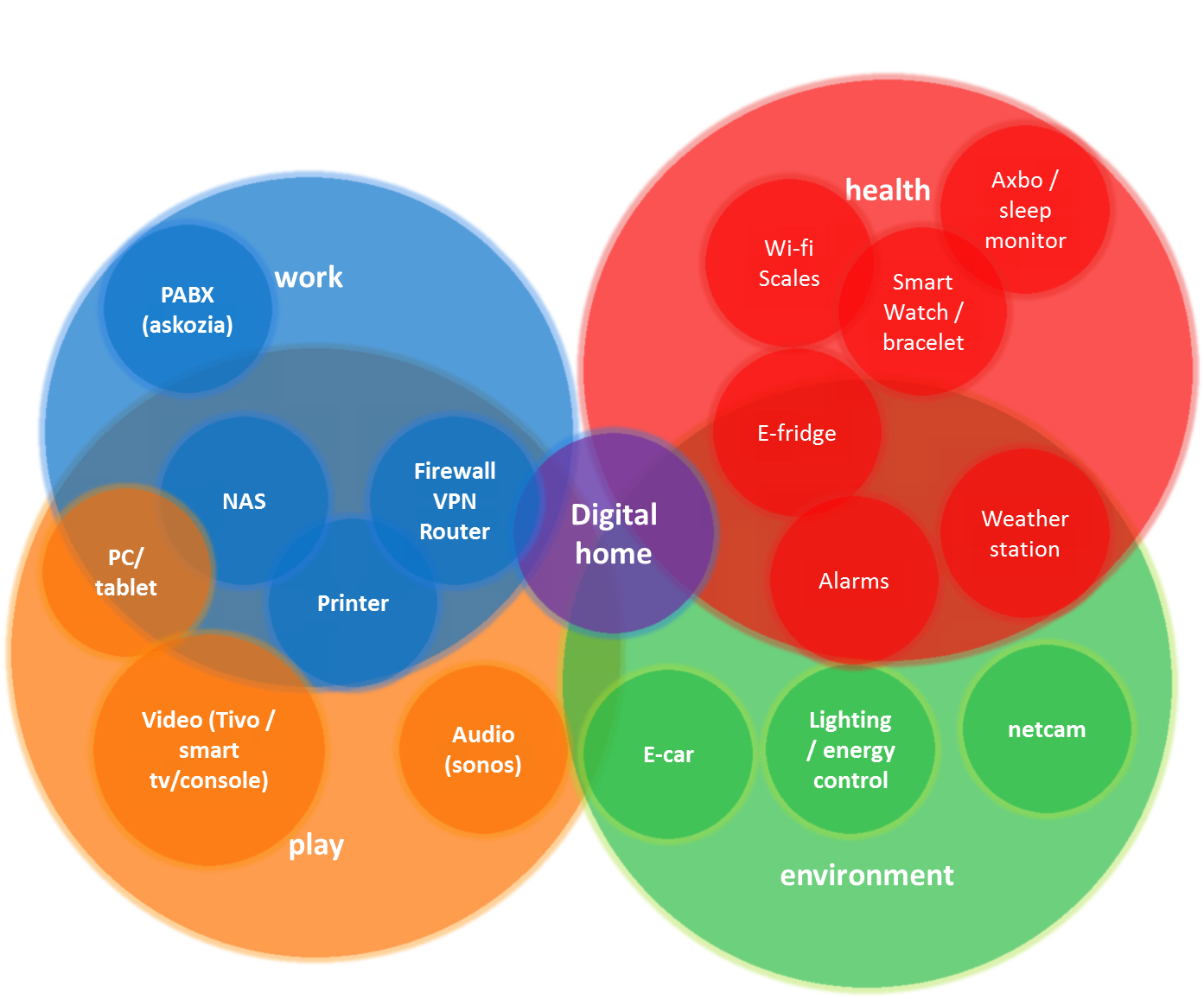
So this got me thinking, what other opportunities are there in the household, and how often do we use them / how important are they. I tried to put this together simply over a year ago, but ironically been tied down working hard, and thought I would share it. The Venn circles are at the moment just built around what makes up my automated home, and size roughly dictated by how many devices / how often they are used.

My Automated home by devices and 4 simple categories: Work, Play, Health and environment

2014 has seen many entrants into digital home, Google with Nest, Samsung et al with smart wearables...
It surprised me how little is actually work related, despite me working from home most of the time when I am not on a client site, and the fact that I must be one of the few people where PABX is on my home automation list and have and army of NAS (not sure what the collective noun for NAS is??? suggestions???) This has certainly changed, as the SOHO was a key target of early digital homes...

I was more surprised how little "play" there was as well, especially after deleting the Playstation due to it being relegated to smart TV and blueray duties (hence inflated smart TV, etc. bubble), and the phone / tablet being prime game console.

So the two bigger diagrams are health and environment, which is where the array of smart watches and companies like Nest are playing, and where e-cars, e-bikes, and the future of utilities is headed... (smart meters, personal solar/wind supplementing the grid, low energy and where Google is also looking to get inverters. This latter part will take a while; as we offload the batteries from e-cars that are under their 3 year 80% power output cycle, but still are over 60% and more than enough to power most things in the house except white goods.. charging them by wind or solar will be a logical step....

I shall be looking at ways of developing this diagram over time, any suggestions welcome...

Friday, 28 December 2012

connected car, home (and bike) m2m finally becoming reality with e-cars?

A few things have come together over 2012 to make me think the connected car is finally becoming a reality (but then next year has been the year of mobile payments since 2006...)

Firstly, earlier this year my colleague Keith, himself looking at getting an all electric car and on the subject of an "emerging apps" project for a client, suggested that electric car apps, and electric cars are finally becoming "desirable", with the app providing the knowledge gap and easing the pain of adoption.
Nissan Leaf app allows the user to see charge, start aircon, etc remotely
Some of which is the info and even "geek chic" of having an app to see the level of charge the car as, and probably more importantly to constantly have in your pocket proof that you can see of how wonderful a human being you are by being so green. No doubt the urge to occasionally tweet and post about this from said mobile also happens...
Electric vehicle parking and charging point opposite two cafes in Berkeley Sq.
The charging point in Berkeley Square in London (pronounced like Barclay if you are from a country that misspells the word colour) in Mayfair is a great perk of going electric, for now at least: drive into central London using the preference lanes, without paying congestion, parking in premium locations with free top-up of juice and a caffeine jolt for you opposite.

Secondly, I recently paid a visit to one of the Scottish and Southern Electricity (SSE) offices in Scotland, or Scottish Hydro as it is known there, precisely the Waterloo Street office in Glasgow where there is a marketing suite at shop floor level. For those who do not know, SSE is the leader by a long way in the UK in hydro and wind power generation, and so SSE have the right to boast a little about these efforts with a very well put together marketing suite where customers can walk in and even try and electric vehicle.
A visit to a showroom like this makes you want to trade in your mobile with all-you-can-eat tariff for a  car
In this showroom are a couple of blah cars (I really cannot be bothered looking them up) but there was the adorable Renault Twizzy, which will soon be joined by other e-cars people actually want, all the way up the the amazing Fisker Karma. Next to them are electric scooters, and while I am aware of the universal and long-lived appeal of the Vespa, there was nothing that got me excited in any way, neither did the e-bikes there.

Having said that, you only have to look at the audi e-bike video, especially with its associated app to ease (and tease) the change.

More real world are bikes like the specialized turbo which have gone for an integrated computer rather than an app, but we all know that people really want either their phone docked here charging, or at least in their pocket to control the device and keep it locked from reasonable levels of temptation. It would not be hard at all to add Bluetooth or wi-fi to the existing computer (the one that controls the electrics, not the display unit!) and have some smartfone goodness to check the state of your battery before you go to bed without having to brave the dark and cold of the garage...
The specialized turbo makes e-bikes a must-have, but how do you check its charge remotely?
If you are not electrified so far, Garmin or some 3rd party apps like Torque can give you a feel or getting info from your car as covered in my app blog. Anyone who is a cyclist will already have a Garmin Edge500 or Edge800 to ensure all the glory detail is captured.
Connected car made easy with Android
The final step is controlling your house, which is now well on its way from companies like lightwave rf allowing you to control your spend and lighting and heating from your armchair; even if that armchair happens to be in your local cafe or your club. As silly as this may sound, I have been using it for a while and its actually very useful, from being able to turn the lights on from your phone when you have a coffee in one hand and your breakfast in another, you plonk yourself in the sofa in the dark and turn the lighting slowly up as the caffeine seeps in, what can I say, its the little things!
Controlling your lighting by room or mood or form a far is where it is going 
So where is this going and, more to the point - why is it all coming?

  1. Well, for one, the smartfone has come of age, which for the likes of Sonos and controlling, who managed to get the early adopters with a dedicated controller, this key extra hardware and cost has gone away. 
  2. This also means one device does all, you control your car and your bike and your music and your TV and your... from one device
  3. The pain of adoption is lower - the main thing stopping the e-car is: where do I charge, where do I park, how will I know when... the answer is: its all in an app!
  4. the measure of the benefit it tangible (and if you are socially inclined, shareable) which means in simple marketing terms, that its easier to get early adopters, who in themselves market to the me-too market who in turn will promote to the mass market...
So what are we waiting for? Well some things never change; just like with convential cars - I was drawn in by a Renault Twizzy and ended up configuring a Fisker Karma - I just need to settle somewhere in the middle.