
Why is the digital home finally coming around? its BI (Business Intelligence) probably
The automated home has been a long time coming, over 10 years ago I marvelled at the remote control curtains in his UK house that my colleague Keith could command from his holiday home in Florida, however, while very impressive, and capable of doing many things, the reality was that putting it together was not easy, even the hardware design of X10 stuff was very "engineer with no brief or requirements" which meant usability was low and a knowledge of coding necessary.
Years have gone y and things moved on; and while products like the nest weather station, connected cars, etc. I suddenly came out of new year's celebrations with a 2014 full of home automation, first we had Google buying Nest and the whole world, including giant Samsung joining the smart watch race.
But why is 2014 connected home year all of a sudden? Why these purchases? Well for me its simple; from years of building MVNOs I have seen that thoese that truely know their customers and can adapt their BI to fit win. They don't just win by a small amount, like the majority of companies that constantly mine their BI for small, incremental gains, these are companies that leverage what they know about their customers and say:
"these are our first 100,000 customers who will buy our new mobile service because they have bought this, this and this from us, they consume this media, live in this area, have this sociodemo group, and we are marketing them both directly and indirectly in these ways that achieve this conversion"
And they do that as the key to understanding them is how they live and from that what makes them tick, or otherwise, what makes them buy. Clever supermarkets get this data from your credit cards and shopping bills (place and sociodemo group as well as purchase preferences) for example. But what to do if your customer is more anonymous? what to do if your BI is not up to scratch? well buy a company or create a product that can give you this data that fits with your business.
The Google Nest acquisition will tell Google how many people there are in a household, the sociodemographic derived from location, when the house is heated and spend, how people share households, who manages certain aspects of a household, etc. Even anonymously, this data can tell you how to charge effectively for ads to the household and mobiles and can be critical for their core business.
Samsung sells fridges and phones and TVs, combine these with a smart watch that can tell when people exercise and preferably what they do or should eat, and the ecosystem from what entertainment products to the really smart fridge starts coming together with real data - not some guys in a room trying to come up with products based on his or her own personal experience.
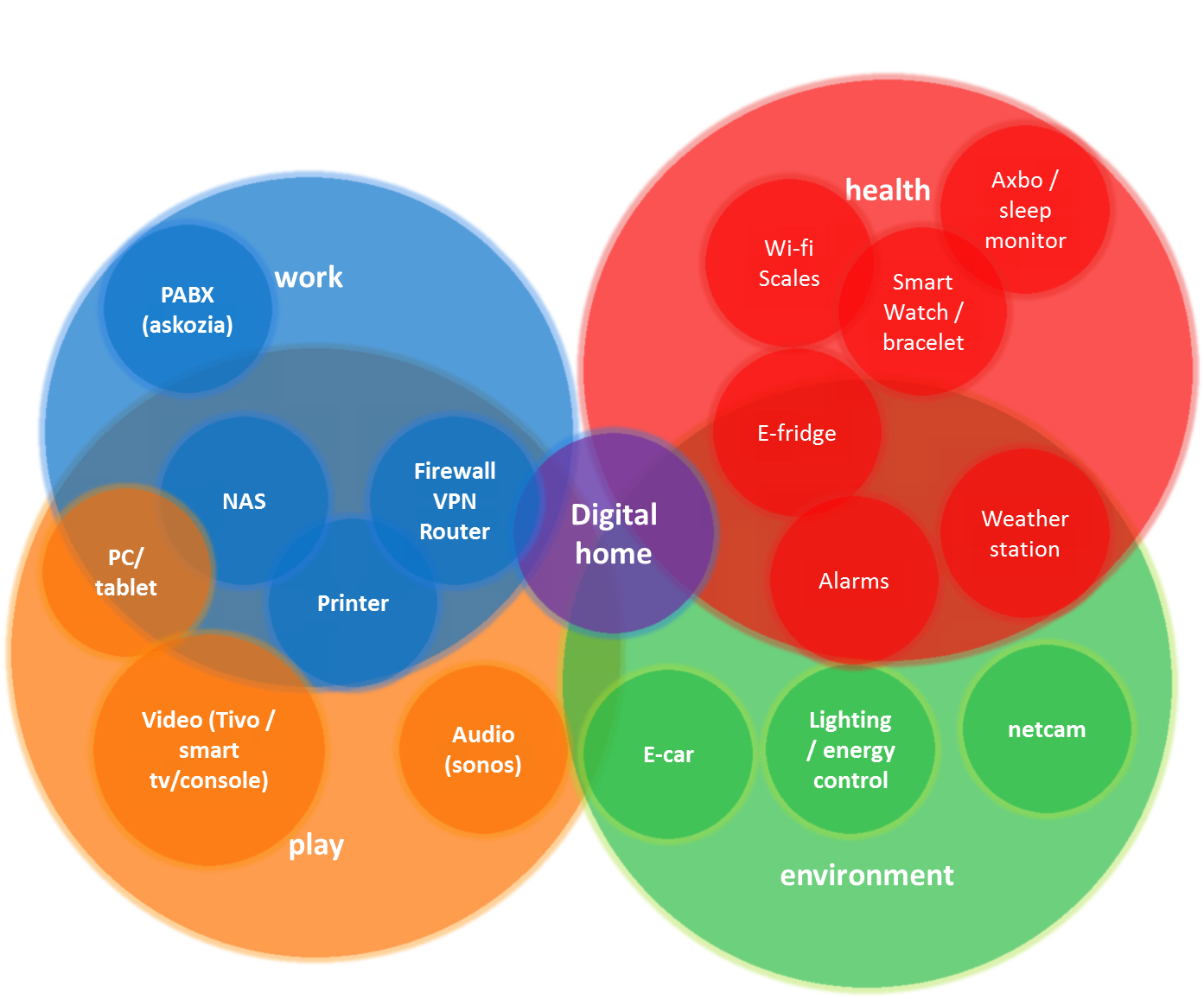
So this got me thinking, what other opportunities are there in the household, and how often do we use them / how important are they. I tried to put this together simply over a year ago, but ironically been tied down working hard, and thought I would share it. The Venn circles are at the moment just built around what makes up my automated home, and size roughly dictated by how many devices / how often they are used.
It surprised me how little is actually work related, despite me working from home most of the time when I am not on a client site, and the fact that I must be one of the few people where PABX is on my home automation list and have and army of NAS (not sure what the collective noun for NAS is??? suggestions???) This has certainly changed, as the SOHO was a key target of early digital homes...
I was more surprised how little "play" there was as well, especially after deleting the Playstation due to it being relegated to smart TV and blueray duties (hence inflated smart TV, etc. bubble), and the phone / tablet being prime game console.
So the two bigger diagrams are health and environment, which is where the array of smart watches and companies like Nest are playing, and where e-cars, e-bikes, and the future of utilities is headed... (smart meters, personal solar/wind supplementing the grid, low energy and where Google is also looking to get inverters. This latter part will take a while; as we offload the batteries from e-cars that are under their 3 year 80% power output cycle, but still are over 60% and more than enough to power most things in the house except white goods.. charging them by wind or solar will be a logical step....
I shall be looking at ways of developing this diagram over time, any suggestions welcome...
The automated home has been a long time coming, over 10 years ago I marvelled at the remote control curtains in his UK house that my colleague Keith could command from his holiday home in Florida, however, while very impressive, and capable of doing many things, the reality was that putting it together was not easy, even the hardware design of X10 stuff was very "engineer with no brief or requirements" which meant usability was low and a knowledge of coding necessary.
Years have gone y and things moved on; and while products like the nest weather station, connected cars, etc. I suddenly came out of new year's celebrations with a 2014 full of home automation, first we had Google buying Nest and the whole world, including giant Samsung joining the smart watch race.
But why is 2014 connected home year all of a sudden? Why these purchases? Well for me its simple; from years of building MVNOs I have seen that thoese that truely know their customers and can adapt their BI to fit win. They don't just win by a small amount, like the majority of companies that constantly mine their BI for small, incremental gains, these are companies that leverage what they know about their customers and say:
"these are our first 100,000 customers who will buy our new mobile service because they have bought this, this and this from us, they consume this media, live in this area, have this sociodemo group, and we are marketing them both directly and indirectly in these ways that achieve this conversion"
And they do that as the key to understanding them is how they live and from that what makes them tick, or otherwise, what makes them buy. Clever supermarkets get this data from your credit cards and shopping bills (place and sociodemo group as well as purchase preferences) for example. But what to do if your customer is more anonymous? what to do if your BI is not up to scratch? well buy a company or create a product that can give you this data that fits with your business.
The Google Nest acquisition will tell Google how many people there are in a household, the sociodemographic derived from location, when the house is heated and spend, how people share households, who manages certain aspects of a household, etc. Even anonymously, this data can tell you how to charge effectively for ads to the household and mobiles and can be critical for their core business.
Samsung sells fridges and phones and TVs, combine these with a smart watch that can tell when people exercise and preferably what they do or should eat, and the ecosystem from what entertainment products to the really smart fridge starts coming together with real data - not some guys in a room trying to come up with products based on his or her own personal experience.
So this got me thinking, what other opportunities are there in the household, and how often do we use them / how important are they. I tried to put this together simply over a year ago, but ironically been tied down working hard, and thought I would share it. The Venn circles are at the moment just built around what makes up my automated home, and size roughly dictated by how many devices / how often they are used.
My Automated home by devices and 4 simple categories: Work, Play, Health and environment
 |
| 2014 has seen many entrants into digital home, Google with Nest, Samsung et al with smart wearables... |
I was more surprised how little "play" there was as well, especially after deleting the Playstation due to it being relegated to smart TV and blueray duties (hence inflated smart TV, etc. bubble), and the phone / tablet being prime game console.
So the two bigger diagrams are health and environment, which is where the array of smart watches and companies like Nest are playing, and where e-cars, e-bikes, and the future of utilities is headed... (smart meters, personal solar/wind supplementing the grid, low energy and where Google is also looking to get inverters. This latter part will take a while; as we offload the batteries from e-cars that are under their 3 year 80% power output cycle, but still are over 60% and more than enough to power most things in the house except white goods.. charging them by wind or solar will be a logical step....
I shall be looking at ways of developing this diagram over time, any suggestions welcome...

